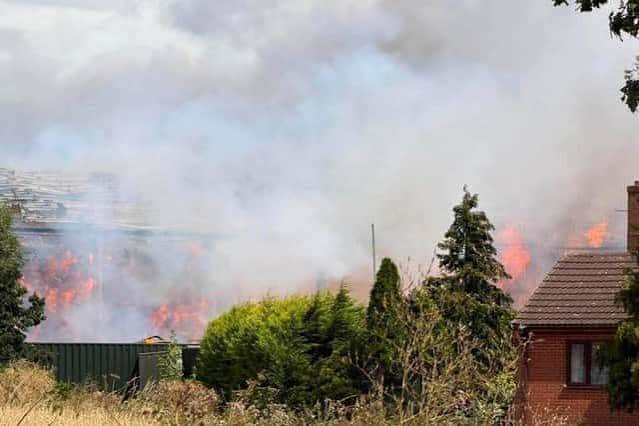
Britain is now a wildfire country. Here is what is driving the current UK wildfire season, which areas are most at risk, and the practical steps households can take to reduce fire risk and prepare for evacuation.
Wildfire used to be something the British watched on the news from California, Portugal or Australia. That framing is now out of date. After a run of dry springs, record-warm summers and long rain-free spells, UK fire and rescue services have spent recent seasons dealing with grass, gorse, heath and moorland fires at a scale the country was never structured for. The current wildfire season has again seen crews stretched across multiple simultaneous incidents, with wildfire warnings issued for large areas of open countryside.
The mechanics are simple and they are not really about heat. Wildfire needs three things: dry fuel, an ignition source and wind. Britain grows fuel extremely well — grass, bracken, heather, gorse and conifer plantations put on huge volumes of growth in a wet spring. When that growth cures out in a dry, sunny spell, the landscape becomes a bed of fine fuels that will take a spark instantly. Add a stiff breeze across open moorland and a small ignition becomes a running fire front in minutes.
Almost every UK wildfire is human-caused. Disposable barbecues on dry ground, campfires left smouldering, cigarette ends, sky lanterns, sparks from machinery or vehicle exhausts on verges, glass and litter, controlled burns that escape, and deliberate ignition together account for the overwhelming majority of incidents. That is the uncomfortable good news: unlike lightning-driven fire regimes abroad, most of our wildfire problem is preventable behaviour rather than an act of nature.
The highest-risk terrain is well mapped by experience: upland moorland in the Peak District, the South Pennines and the North York Moors; lowland heath in Surrey, Dorset, Hampshire and the Brecklands of East Anglia; the gorse-covered coastal fringes of Wales, Cornwall and Northern Ireland; and the vast dry heath and forestry of the Scottish Highlands. Peat is the specific British nightmare: once fire gets into dried peat it burns downward, can smoulder underground for weeks, and reignites the surface long after the visible flames are out.
The risk that matters to households is the wildland–urban interface — the edge where housing meets open ground. If your garden backs onto heath, moor, a golf course, a railway embankment, a forestry block, a field of standing crop or an unmanaged scrub margin, you are in that interface. Homes are rarely lost to a wall of flame arriving; they are lost to embers, which travel ahead of the fire on the wind and find something combustible against the building.
Reducing that risk is mostly housekeeping. Keep a defensible zone of roughly five metres around the property free of easily ignited material: no stacked firewood, gas bottles, wheelie bins, fence panels, decking clutter, dry hedging or garden furniture cushions against the walls. Clear gutters and roof valleys of dead leaves and needles, which are perfect ember traps. Cut and water grass close to the building during dry spells, remove dead vegetation, and prune tree branches away from the roofline. Where you can, favour gravel, paving or short green lawn immediately against the house rather than bark chip and dry bedding.
Then close the building up. Embers get in through gaps: airbricks, soffit vents, open windows, cat flaps, loose roof tiles and under-floor voids. Fine metal mesh over vents, well-fitted tiles and shut windows during a nearby fire do more for a British house than any amount of hose water. If smoke is drifting toward you, shut windows and doors, turn off mechanical ventilation, and keep people with asthma or heart conditions indoors — wildfire smoke is a serious health hazard well beyond the fire ground itself.
Prepare for the possibility of leaving. UK wildfire evacuations are usually precautionary, short and announced with very little warning — sometimes a knock on the door and twenty minutes. That is exactly what a grab bag is for: documents, medication for at least a week, phone chargers and a power bank, cash, water, food, torches, a change of clothes, sturdy footwear, pet supplies, and car keys. Fuel the car when a fire risk warning is in force and park it facing the road. Agree a meeting point and an out-of-area contact in case local mobile networks are congested.
During a nearby fire, keep information flowing. Follow your local fire and rescue service and the Met Office for warnings, and keep a wind-up or solar DAB radio in the kit — local radio remains the most reliable channel when networks are overloaded. Never drive toward smoke to look. Never assume a fire that has passed is out; check the boundary of your property for smouldering fence bases, sleepers, hedges and peat.
Countryside behaviour is the other half of the answer. During dry spells, do not use disposable barbecues or light fires on open land at all — many landowners and councils now ban them outright and the fine matters far less than the damage. Take litter and glass home, park off dry grass because catalytic converters routinely start verge fires, and report smoke immediately by calling 999 with a grid reference or what3words location. Early reporting is the single biggest factor in whether a fire is a half-hour job or a three-day operation.
For households wanting practical equipment, the useful kit is unglamorous: a working smoke alarm on every floor, a fire blanket and an appropriate extinguisher, a long hose that reaches every side of the house, FFP2 or FFP3 masks for smoke, goggles, work gloves, and a grab bag already packed. A spade and a metal rake are more use than anything else for beating out a small ignition in a garden or verge before it establishes.
The honest summary is that UK wildfire risk is now a normal seasonal hazard rather than an exotic one, and it responds extremely well to preparation. Clear the ground around the house, seal the gaps, pack a bag, don't be the ignition source, and know what you would do with twenty minutes' notice. That is nearly all of it.
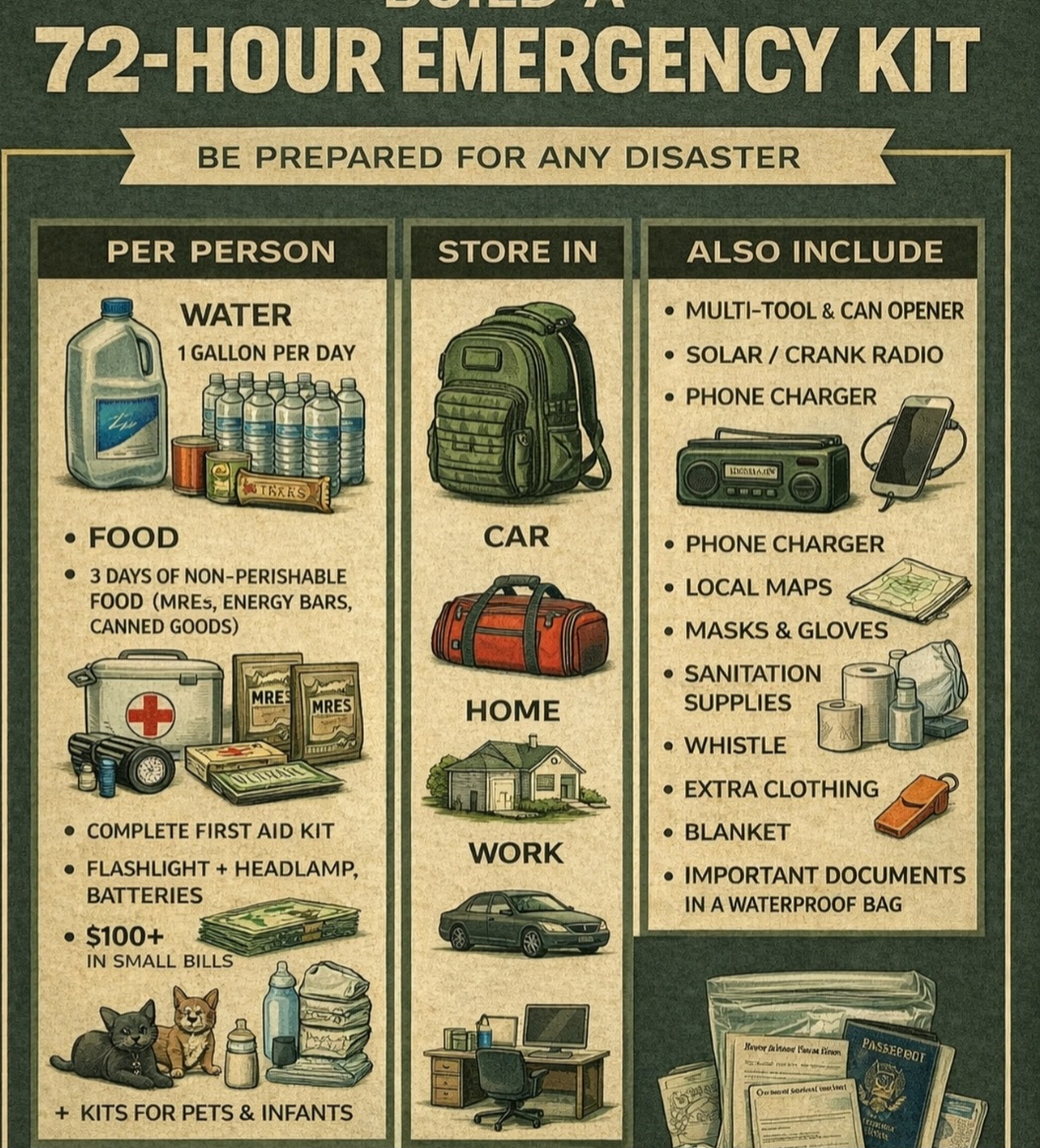
How to Build a 72-Hour Emergency Kit (UK Checklist)
The first three days of any emergency are the ones you handle alone. Here is exactly what goes in a 72-hour kit for a UK household — per person, per vehicle, per home.