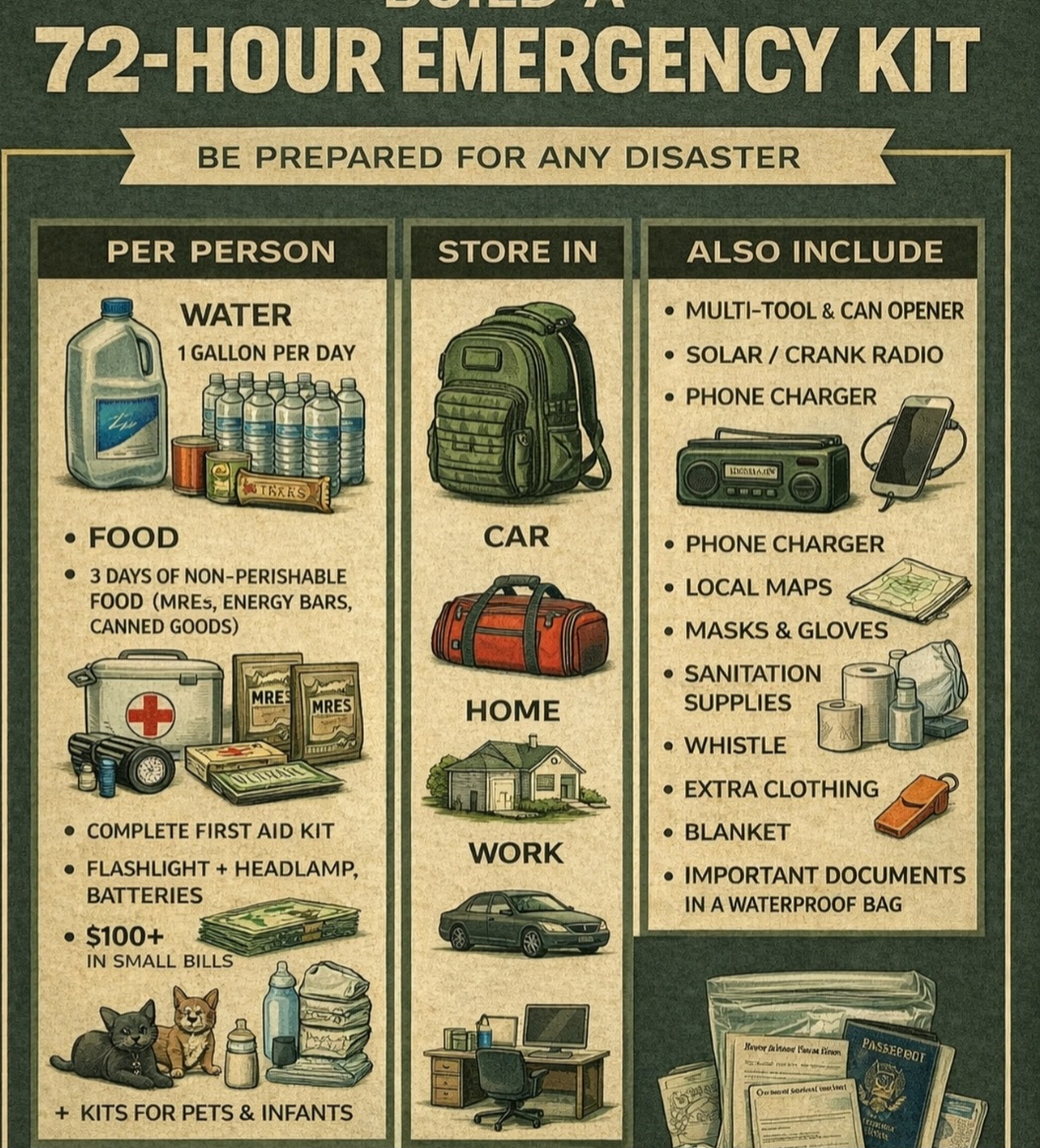
The first three days of any emergency are the ones you handle alone. Here is exactly what goes in a 72-hour kit for a UK household — per person, per vehicle, per home.
Seventy-two hours is the planning window used by almost every civil resilience agency in the world, and the logic behind it is simple: three days is roughly how long it takes for organised help to reach most people after a serious disruption. Storms, floods, extended power cuts, water main failures and localised incidents all tend to resolve — or at least stabilise — inside that window. Your kit is not a survival fantasy. It is a bridge across those three days.
Start with water, because it is the constraint that kills the fastest. Plan on roughly four litres per person per day: three for drinking, one for basic hygiene and food preparation. For a family of four that is 48 litres for three days, which sounds absurd until you realise it is four supermarket packs of bottled water under the stairs. Add a filter straw or gravity filter as backup so that a tap, a rain butt or a stream becomes drinkable if the stored water runs down.
Then food. Three days of non-perishable food that requires no cooking and no refrigeration: tinned goods with ring pulls, ration biscuits, energy bars, nut butter, dried fruit, and freeze-dried meals if you have a way to heat water. The rule is to store what you actually eat and rotate it, not to buy exotic rations you will never open. Don't forget a manual can opener — it is the single most commonly forgotten item on every kit list ever written.
Light, power and information come next. A torch and a headtorch per person, spare batteries, and a power bank large enough for two full phone charges. Critically, add a wind-up or solar DAB/FM radio. When mobile masts exhaust their backup batteries — typically within a few hours of a grid failure — broadcast radio becomes the only reliable channel for official instructions.
A proper first aid kit is next, and 'proper' means more than plasters: a trauma dressing, a tourniquet if you are trained to use one, wound closure strips, antiseptic, burn gel, painkillers, and at least seven days of any prescription medication your household depends on. Prescription supply is the most under-planned failure point in British preparedness; pharmacy chains run on daily deliveries.
Then the small kit that solves a hundred problems: a multi-tool, gaffer tape, work gloves, a whistle, N95 masks, bin bags, wet wipes, hand sanitiser, and sanitation supplies. If mains water fails, a bucket, bin liners and cat litter make a functioning toilet — an unglamorous detail that becomes urgent by hour thirty.
Add warmth and shelter appropriate to a British winter: a foil blanket per person, one proper wool or fleece blanket, a spare set of warm clothes, waterproofs and sturdy boots. Most UK emergencies are cold and wet rather than hot and dry, and hypothermia in an unheated house is a genuine risk for the elderly during a multi-day winter outage.
Finally, documents and cash. Copies of passports, insurance policies, prescriptions, bank details and a paper list of phone numbers, all in a waterproof wallet. Keep £100–£200 in small notes: card readers and cash machines fail together when power or networks go down, and change is hard to come by when nobody can process a card.
Store the kit in three places. A rucksack per adult holds the portable core — this is the bag that leaves the house if evacuation is ever ordered. A larger box at home holds the bulk water, food and sanitation supplies. A slim kit lives permanently in the car boot: torch, foil blankets, water, snacks, first aid, hi-vis and a phone cable. Many people are away from home when an incident starts, and a car kit covers the gap.
Two more categories that get overlooked: pets and infants. Three days of pet food, a bowl and a lead. Formula, nappies, wipes and a sterilising method for babies. Neither is optional if either lives in your house.
Check the kit twice a year — the clock changes are a convenient prompt. Rotate food and water, test the torches, replace expired medication, top up the cash, and update the document copies. A kit that has not been checked in three years is a box of expectations, not equipment.
Build it once, in an afternoon, and it stops being a worry. That is the entire point: preparedness should be a completed task, not an ongoing anxiety.
Why You Should Stay Indoors During a Crisis
Almost every serious UK emergency is survived at home, not in the woods. Here is the case for sheltering in place — and what it demands of your house.