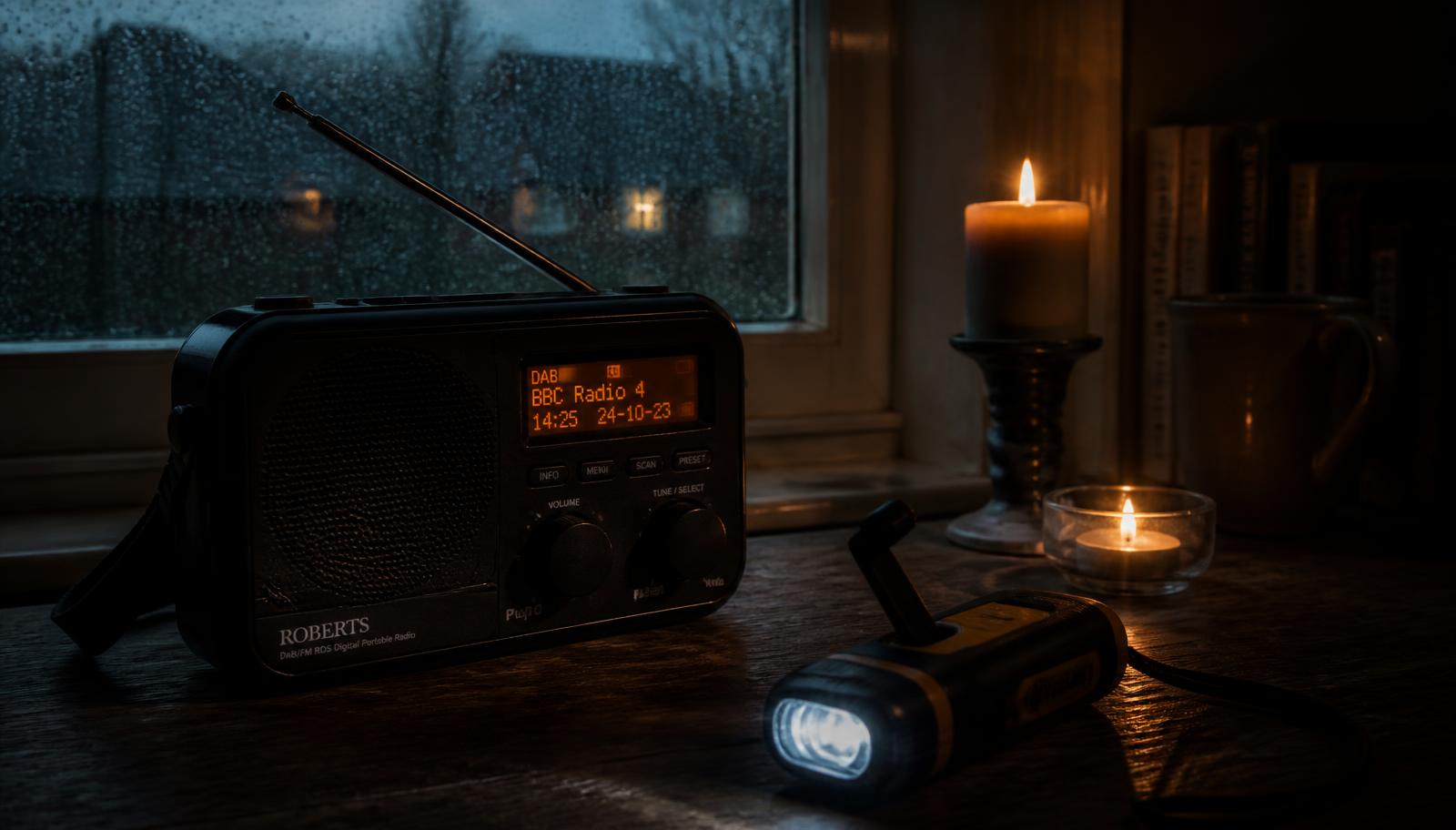
On 27 June 2026 the BBC switched off Radio 4 on long wave for the last time, closing the one broadcast that reached almost the whole of the UK on a cheap receiver. Here is what still works when the power, the mobile network or the internet goes down — and how to build an information plan that does not depend on any single one of them.
For nearly a century, 198 kHz long wave was the fallback everyone in UK preparedness circles quietly relied on. One national signal, receivable from Cornwall to Shetland and well out into the North Sea, on a receiver costing a few pounds and running for weeks on dry cells. The BBC ended Radio 4 long wave broadcasts on 27 June 2026 because the third-party transmitter infrastructure at Droitwich, Westerglen and Burghead reached the end of its working life. Whatever you think of the decision, the practical effect is the same: the simplest single point of national information is no longer there, and a lot of grab bags now contain a radio tuned to a dead frequency.
Start by being clear about what actually fails in a UK emergency, because it is rarely everything at once. Storm outages take down mains power and, once the batteries in the mobile masts flatten — often within a couple of hours — they take the mobile network with it. Flooding takes out local exchanges and roads. A cyber incident against a utility or a payment processor leaves the lights on but the systems dark. Each of those breaks a different link in your information chain, so the plan has to be layered rather than clever.
Layer one is broadcast radio, and it still works. FM and DAB transmitters run from the grid but most major sites have standby generation, and your receiver does not care whether your own street has power. A battery or wind-up DAB/FM set with a spare pack of alkalines covers national news, and — more useful in a local emergency — BBC local radio, which is the designated emergency broadcaster and the channel local resilience forums actually use for evacuation, boil-water and road-closure messages. Write your local BBC station's FM frequency on masking tape and stick it to the back of the radio. In the dark, with no display backlight and no internet to look it up, that scrap of tape is the whole point.
Layer two is the Emergency Alerts system. UK mobile phones receive government alerts over cell broadcast, which does not need a signal bar's worth of data or your number to be known to anybody — but it does need a live mast and a charged phone. That makes it excellent for the first hour of a sudden event and useless on day three of an outage. Keep the alerts switched on in your phone's settings, and keep a power bank charged so the phone survives long enough to matter. Two 10,000 mAh banks, topped up on the first of every month, are enough to keep a handset alive for several days of light use.
Layer three is the internet, and it deserves less trust than most households give it. Home broadband dies with the mains unless the router is on a small UPS, and even then the street cabinet may not be. Mobile data disappears when the masts run out of battery. What you can do cheaply is prepare offline: save the Environment Agency flood warning page, your water company's incident page, your DNO's power cut number (or the national 105 service) and your council's emergency page as offline copies or screenshots, and print the numbers on a single card in the kit. A phone with no signal can still read a screenshot.
Layer four is the one people skip: two-way. A pair of PMR446 handsets costs very little, needs no licence, and solves the problem broadcast radio cannot — talking to the people in your own household when one of you is at work, at school, or checking on a relative two streets away. Range in a built-up area is realistically a few hundred metres to a kilometre, so agree a listening schedule rather than expecting a constant channel: on the hour, for five minutes, on an agreed channel. Amateur radio goes considerably further if anyone in the house is willing to sit the Foundation licence, and UK amateur networks have a long history of passing traffic in emergencies.
Tie the layers together with something written down. A single laminated card in the kit should carry: your local BBC station frequency, the 105 power cut number, 0345 988 1188 for Floodline, your water company's emergency line, the GP surgery, two out-of-area contacts, and the agreed PMR channel and listening times. Out-of-area contacts matter more than people expect — in a regional event, local circuits congest while a call or text to a relative two hundred miles away often gets through, which makes them a useful relay between family members who cannot reach each other directly.
Test it once a year, ideally in winter. Kill the consumer unit for an evening. Find out whether the torch batteries have leaked, whether anyone can actually tune the radio in the dark, whether the power banks hold charge, and whether the card is where you thought it was. Every failure you find on a Tuesday evening is one you are not discovering during an actual storm.
None of this is expensive. A DAB/FM radio with real battery life, a decent torch, two power banks, a pair of PMR446 handsets and a printed card come in well under the cost of a weekly shop, and they cover the single most common gap in UK household preparedness: not the absence of food or water, but the absence of any way to find out what is happening and tell anyone where you are. Long wave was doing that job quietly for ninety years. It is worth replacing deliberately rather than assuming your phone will cope.
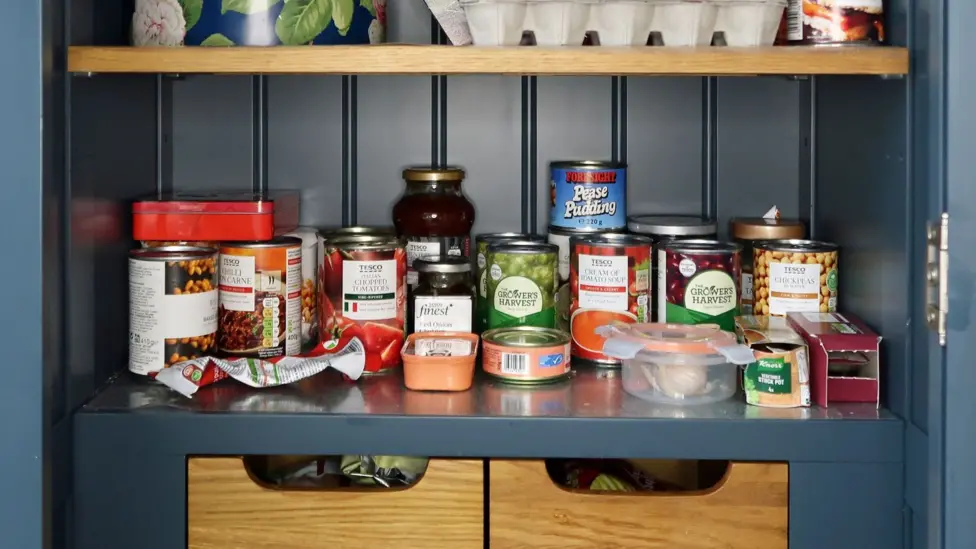
UK Government Urges Households to Stockpile Food
The Environment Secretary has told UK households to stock up on food ahead of the strongest El Niño in a generation, as the National Audit Office warns Britain's food supply chain is exposed to extreme weather, cyber-attacks and disease. Here is what was actually said — and what a sensible household stockpile looks like.