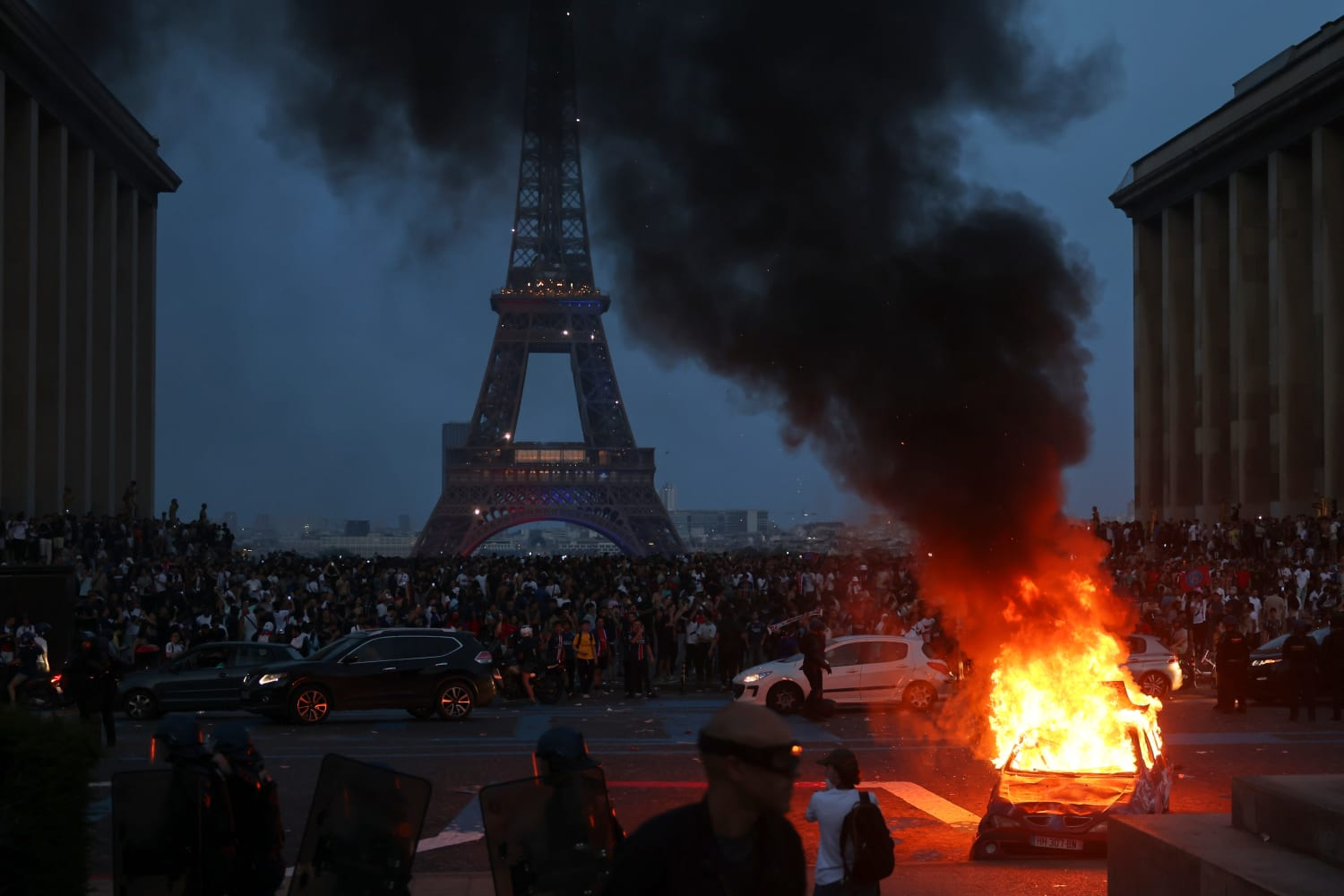
Paris burns again. Behind the burning cars and lines of riot police sit two forces that are not going away — a strained economy and one of Europe's most rapid demographic transformations. Why France keeps exploding, and what it means for the rest of the continent.
The images have become grimly familiar. A burning car under the shadow of the Eiffel Tower, smoke hanging over the Trocadéro, riot police holding the line in dusk-lit streets. France has been here before — in 2005, 2023 and repeatedly since — and the speed at which a local death or a heavy-handed police stop can turn into nights of nationwide disorder tells you something structural has changed. This is not random vandalism. It is the visible pressure of two forces that France, and much of Western Europe, has carried for years without resolving.
The first force is economic. France's headline unemployment looks tolerable at European levels, but the averages hide a brutal split. Youth unemployment in the country's poorest neighbourhoods runs at three to four times the national rate. The banlieues — the high-rise districts that ring most of France's major cities — were built as working-class housing and now function as engines of exclusion: long commutes, underfunded schools, and a local economy that largely stops at the tram terminus. The Maastricht-era social model that once promised a job-for-life with benefits simply no longer exists for a generation raised inside those ring roads.
Strain does not come from poverty alone. It comes from the gap between what the system promises and what it delivers. Inequality in France has grown while public services in the poorest districts have thinned — post offices, youth centres and police stations replaced by a single community liaison officer and a bus that comes twice an hour. When the average rioter in the footage is a teenager with no job, no stake in the neighbourhood and no expectation that the state will fix it, the disorder is less an event than a forecast. Add a cost-of-living squeeze — energy prices and food inflation that hit fixed-income and low-earning households first — and you have a population with little to lose from a car on fire.
The second force is the one everyone in the room knows but fewer say aloud: migration, and the way it has reshaped France and Western Europe faster than their institutions have absorbed. The scale is genuinely unprecedented in peacetime. France and the wider EU have taken in hundreds of thousands of asylum seekers and migrants a year through the 2015 crisis, the Ukraine war, and ongoing arrivals across the Mediterranean, layered on top of decades of post-colonial migration. France is now one of Europe's most ethnically and religiously diverse states, and that transformation has happened within two generations.
The honest picture is mixed. Migrants have filled labour shortages, propped up the health service and paid into systems they have largely been excluded from at the top. But the friction is real and it concentrates geographically: new arrivals gravitate to the same high-unemployment districts, where housing is cheapest and where competition for a shrinking pool of entry-level work and public services is sharpest. Integration through work — the classic French republican answer — breaks down when there is no work. What remains is parallel communities, periodic cultural tension, and a sense on all sides that a neighbourhood's future is decided by forces nobody locally controls. That is the tinder; the economy is the spark.
Why does this look like Europe's future? Because France is not an outlier, it is an early arrival. Britain, Belgium, Sweden, Germany and the Netherlands each carry versions of the same two pressures: sluggish growth with labour markets that no longer absorb the unskilled at a decent wage, and demographic change running well ahead of integration capacity. Sweden, long Europe's model social state, has seen Grenfell-scale gang violence rewrite its policing priorities. Ireland's 2023 anti-immigrant riots and the UK's own summer disorder followed the same pattern — a local incident, weak trust in the authorities, and a decade of grievances catching fire in a single week.
None of this means European cities descend permanently into chaos. States have enormous capacity to absorb even violent disorder, and most nights in most European cities are uneventful. What it does mean is that episodes of civil disorder — once measured in decades between occurrences in France — are now recurring at intervals of a few years, in more countries, triggered by smaller incidents. The frequency curve is going one way, and anyone planning for their household should read it for what it is: not a prediction of collapse, but a rise in the base rate of short, sharp local disruption.
For a UK household, the practical lessons from the French footage are mundane. Civil unrest is rarely something you escape in a car — it is something you wait out indoors. That means keeping the doors secure and out of view, keeping a few days of food and water so nobody has to cross a tense high street for a loaf, having light and power if the street utilities are disturbed, and a charged radio or phone so you know when it is actually over. Households in urban districts should note which exits and roads are likely to be blocked, and agree on when the answer is to simply stay inside.
The deeper lesson is the one preparedness people argue about least: social cohesion is infrastructure. When it degrades, the first thing affected is the ordinary stuff — deliveries, transport, the reliability of services — not the dramatic stuff. A household that can run normally through three days of tension nearby has quietly out-performed every headline on this subject.

Radio 4 Long Wave Is Gone: Your UK Grid-Down Information Plan
On 27 June 2026 the BBC switched off Radio 4 on long wave for the last time, closing the one broadcast that reached almost the whole of the UK on a cheap receiver. Here is what still works when the power, the mobile network or the internet goes down — and how to build an information plan that does not depend on any single one of them.